The Founding of the Mediterranean, European, and Middle Eastern Culture Club

(Otherwise known as MEME Club)
The MEME Club (Mediterranean, European, and Middle Eastern Club) was founded to create a space for cultural exchange and celebration across three interconnected regions. What began as a concept between myself and a close friend in the Student Association (SA) grew into an official student organization, hosting successful events such as the Sunset Soiree and Fiesta de Flores. These initiatives not only exceeded expectations, but also filled gaps in the Events programming for SA, offering both cultural depth and fun opportunities for students to connect socially. Below, I provide a detailed reflection on the club’s foundation, journey, challenges, and impact, as well as lessons learned.
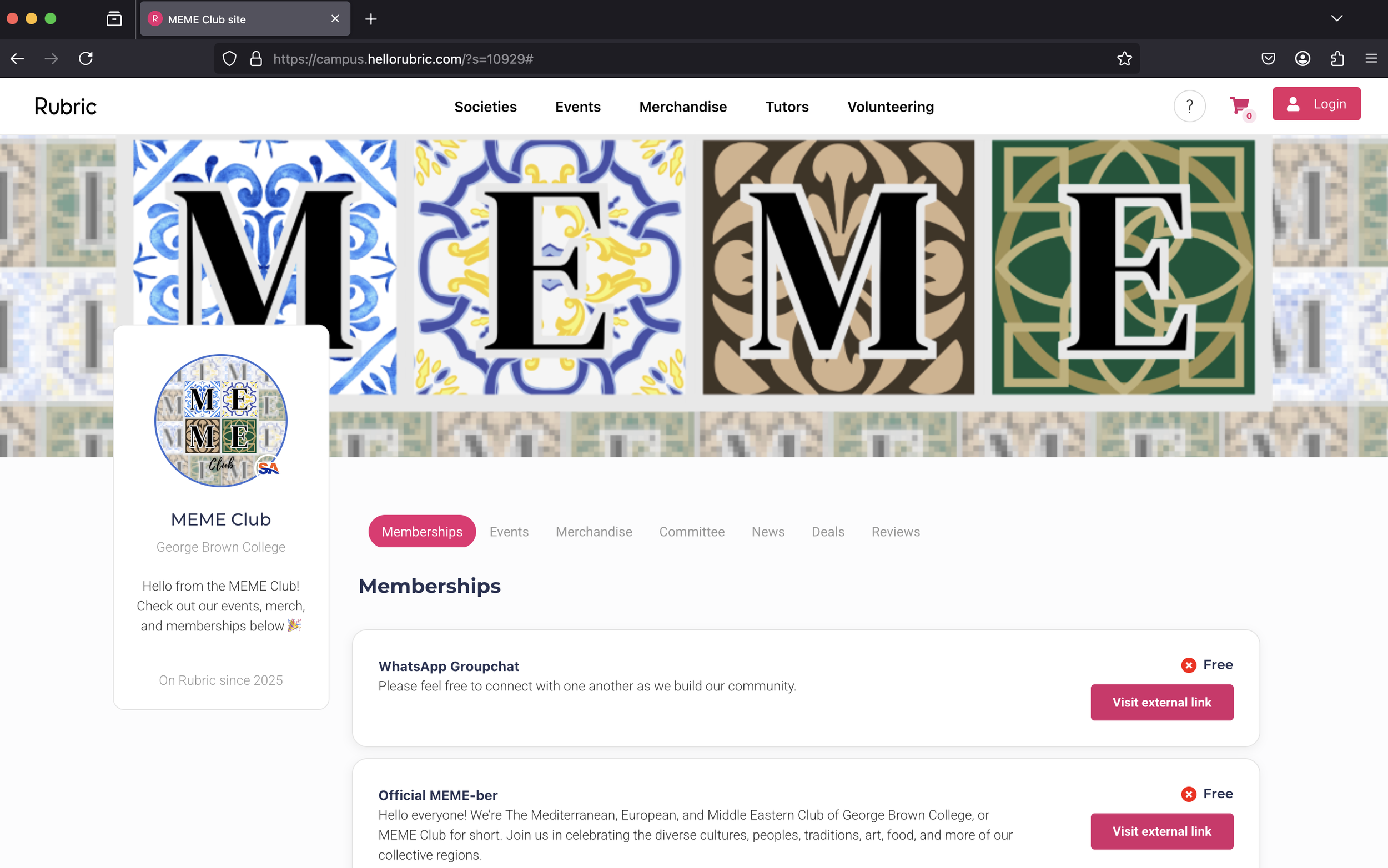
Pictured above is the MEME Club membership page, created under the Student Association’s Clubs departmentDuring my time at George Brown College, I recognized an opportunity to enrich campus life by establishing a new cultural organization. While groups such as NOIR (Black Culture Club) and OLAS (Organization of Latin American Students) were thriving, there was no club dedicated to celebrating the diverse traditions of European, Mediterranean, and Middle Eastern communities. As a member of the Student Association’s Events & Recreation department, I frequently engaged with students who expressed interest in such representation. Their feedback, combined with my own passion for cultural exchange, laid the foundation for what would become the MEME Club.
The concept emerged from a conversation with a colleague who hoped to start a European club. Concerned about how narrowly defining the club might be perceived, I proposed a broader vision that would unite European and Middle Eastern cultures, with the Mediterranean naturally included. From this, the MEME Club was born. Initially, the idea remained dormant due to the fact that my colleague was not allowed to run a club as a Board of Directors Member, and my own time constraints (especially because I was studying intensely for the Ontario Colleges Marketing Competition that semester).
However, in my final semester, circumstances aligned for me to bring the club to life. Working under a field education credit in place of a co-op, I was able to leverage my Student Association role to take on greater leadership responsibilities. With the support of my supervisor, who trusted my judgment and offered resources contingent on my ability to manage logistics, I began formalizing the club’s mission, objectives, and executive team. Despite balancing coursework, two jobs, and a lengthy commute, I committed to building MEME Club into a sustainable organization.
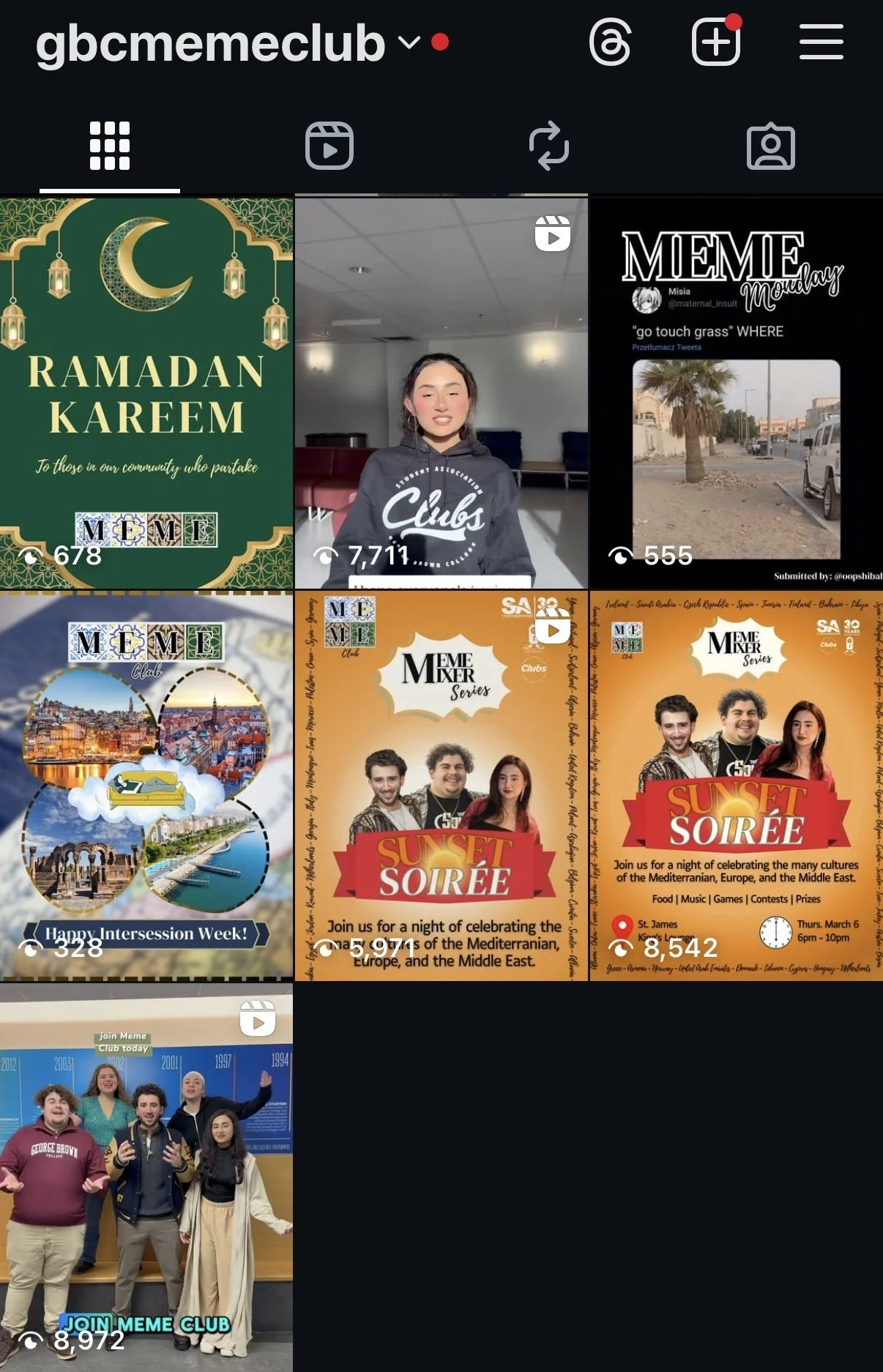
Our first major initiative was the Sunset Soiree, an event designed to honor Ramadan while also incorporating European traditions. Featuring trivia games and a diverse menu that included kebabs and rice, Greek salad, Italian meatballs, and assorted cheeses, the evening fostered cultural exchange and exceeded expectations with a turnout of 35 attendees. The success of this event demonstrated the club’s potential and opened the door for further programming.
Because the Sunset Soiree proved the club’s potential, we were granted approval to host a second event that would fill a gap in Student Association programming. That opportunity led to Fiesta de Flores, a floral-themed dance party loosely inspired by Spanish and Portuguese culture. With Europop music, light snacks, and a few activities sprinkled in, the event was designed as a way for students to de-stress before exams. Despite the challenges of a short four-week planning period and scheduling on the Thursday before exam week, attendance surpassed expectations. Fiesta de Flores not only offered students a much-needed break but also demonstrated how MEME Club could adapt its programming to meet different community needs while complementing existing SA events.
A particularly meaningful moment came at the end-of-year celebration, when my supervisor surprised me with a large activation featuring the logos of the college’s most impactful clubs; seeing MEME Club represented among them affirmed the value of our work and reminded me that true leadership is not about individual effort but about fostering collaboration, trust, and shared ownership.
Pictured above isThrough MEME Club, I learned to problem-solve under pressure, manage a team effectively, and balance budgets while successfully appealing for additional funds when needed. I took pride not only in turnout numbers but also in the genuine engagement of students who expressed gratitude for the opportunities we created. Leading the club taught me adaptability and resilience, showing me how to balance competing priorities, delegate tasks according to team strengths, and remain composed under tight deadlines or limited resources. I also discovered the importance of listening to community needs and shaping events around both cultural representation and student well-being.
Today, MEME Club continues under the leadership of my former vice president, Shaima Mohammed, who has introduced new programming while maintaining the club’s spirit. Watching the organization evolve and remain a George Brown mainstay is deeply rewarding. What began as an idea between friends grew into a collaborative effort and now stands as a lasting space for cultural celebration and connection.
Check out some more media from my time working on MEME Club below!